
How Do I Choose the Right PTSD Therapy?
Understanding CPT, PE, and EMDR.

PTSD Therapy provides structured trauma therapy for healthcare professionals, first responders, and adults recovering from medical trauma, interpersonal trauma, and other traumatic experiences. Services are provided virtually across Ontario by Shevanthi "Shev" Collure, RSW, Registered Social Worker and Psychotherapist.
If you have been searching for PTSD treatment, you have probably noticed that there are a lot of options.
EMDR is talked about frequently on social media. Friends may have recommended one therapy over another. You may have read about Cognitive Processing Therapy (CPT), Prolonged Exposure (PE), or Eye Movement Desensitization and Reprocessing (EMDR), only to come away feeling more confused than when you started.
One of the things we often hear from clients is:
"I just want to know which therapy is the best."
The honest answer is that there isn't one treatment that is best for everyone.
All three of these approaches are considered evidence-based treatments for PTSD. Each has strong research behind it. They simply help people recover in different ways.
The goal of this article is not to convince you that one therapy is superior to another. Instead, it is to help you understand how they differ so you can make an informed decision about what feels like the best fit for you.
Key Takeaways
CPT, PE, and EMDR are all evidence-based treatments for PTSD.
They each target PTSD symptoms using different methods.
The "best" therapy depends on your symptoms, goals, preferences, and clinical presentation.
No therapy requires you to tell every detail of your trauma before you are ready.
Working with a therapist who regularly treats PTSD is often more important than choosing one specific modality.
First, what makes a therapy "evidence-based"?
When therapists describe a treatment as evidence-based, they mean it has been studied extensively through scientific research.
Researchers compare treatments, follow people over time, and measure changes in PTSD symptoms. The therapies that consistently help large numbers of people recover become evidence-based treatments.
This matters because PTSD is different from general anxiety or stress.
PTSD affects the way the brain processes danger, memories, emotions, and avoidance. Effective treatment needs to address those processes rather than simply providing emotional support or a place to talk.
Supportive therapy absolutely has value. Feeling heard and understood matters.
However, when PTSD symptoms continue to interfere with daily life, many people benefit from a structured treatment specifically designed for trauma.
Why PTSD symptoms don't simply disappear with time
Many people assume that if enough time passes, the memories will fade.
Sometimes they do.
Sometimes they don't.
PTSD develops because the brain stores traumatic memories differently than ordinary memories.
Instead of becoming part of the past, the trauma continues to feel like it is happening in the present.
That is why someone might know logically that they are safe while their body reacts as though the danger has returned.
Common symptoms include:
intrusive memories
nightmares
avoidance
feeling constantly on guard
guilt or shame
emotional numbness
difficulty concentrating
irritability
changes in relationships
feeling disconnected from yourself or others
Some people notice these symptoms immediately after the trauma.
Others don't.
It is actually quite common for PTSD symptoms to emerge weeks or even months later. In some cases, people continue functioning well for a long time before cumulative stress, another traumatic event, retirement, illness, or simply having more space to think allows symptoms to surface.
This delayed presentation often surprises people.
They wonder,
"Why now?"
The answer is often that the brain has finally stopped focusing on survival long enough for the trauma to demand attention.
At a Glance: Comparing CPT, PE, and EMDR
Although these therapies all treat PTSD, they focus on different parts of the recovery process.
The table below provides a quick overview of the similarities and differences. We’ll explore each treatment in more detail afterward.
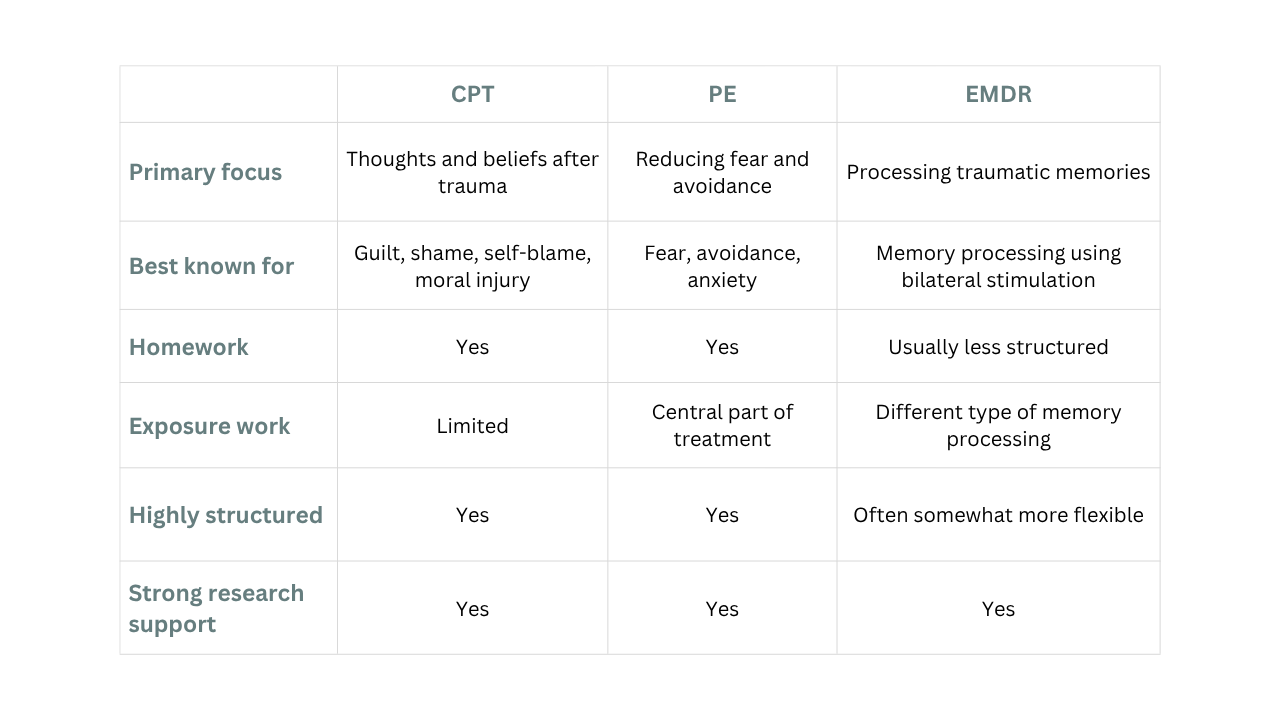
Let's look at each one more closely.
Cognitive Processing Therapy (CPT)
CPT helps people understand how trauma changes the way they think about themselves, other people, and the world.
After a traumatic event, it is very common for people to develop beliefs such as:
"It was my fault."
"I should have done more."
"I'm weak."
"I can't trust anyone."
"Nowhere is safe."
These beliefs are understandable.
They often develop because the brain is trying to make sense of something overwhelming.
Unfortunately, they can also keep PTSD going.
Rather than simply telling yourself to "think positively," CPT helps you examine whether these beliefs are completely accurate, partially accurate, or no longer fit the current reality.
The goal is not to convince yourself that terrible things never happen.
Instead, it is about developing more balanced, realistic beliefs that reduce unnecessary suffering.
For example:
Instead of:
"I failed everyone."
Someone might gradually arrive at:
"I did the best I could with the information and resources I had at that moment."
That shift can significantly reduce guilt while still acknowledging the pain of what happened.
What does CPT look like?
CPT is highly structured.
Most treatment follows a series of sessions that build upon one another.
Clients complete worksheets between sessions to practice identifying unhelpful thinking patterns and learning new ways of understanding the trauma.
This homework is important because real change happens through practice, not simply by attending therapy once a week.
Who tends to benefit from CPT?
CPT is often an excellent fit for people struggling with:
guilt
shame
self-blame
moral injury
healthcare-related trauma
first responder trauma
military trauma
betrayal
difficult decisions made under impossible circumstances
Many healthcare professionals and first responders tell themselves they should have done more.
Even when they objectively could not have changed the outcome.
Helping people examine these painful beliefs is one reason we frequently use CPT within our practice.
Prolonged Exposure (PE)
If CPT focuses primarily on changing unhelpful beliefs, Prolonged Exposure focuses primarily on reducing fear and avoidance.
Avoidance is one of the biggest reasons PTSD persists.
It makes sense.
If something reminds you of the trauma, of course you want to stay away from it.
You might avoid:
certain roads
hospitals
news stories
conversations
driving
crowded places
particular smells
certain times of year
thoughts or memories
The problem is that avoidance provides temporary relief.
Unfortunately, it also teaches the brain that these reminders really are dangerous.
As a result, the world gradually becomes smaller.
People often find themselves avoiding more and more situations over time.
PE helps reverse that process.
What does PE involve?
There are two main parts.
The first involves gradually approaching trauma memories in a safe, structured way with your therapist.
The second involves gradually approaching situations in daily life that have become safe but avoided.
This happens at a pace that is planned collaboratively.
It is never about throwing someone into overwhelming situations.
The goal is to help your brain learn something new:
"This memory is painful, but it is not dangerous."
"This situation reminds me of the trauma, but the trauma is not happening right now."
Over time, anxiety naturally decreases.
More importantly, confidence increases.
People often discover they are capable of handling far more than PTSD had convinced them.
Homework in PE
Like CPT, PE includes homework.
Clients practice approaching situations between sessions rather than continuing to avoid them.
This gradual practice is one of the reasons PE has such strong research support.
Who tends to benefit from PE?
PE is often particularly helpful for people experiencing:
significant avoidance
intense fear
panic around reminders
nightmares
intrusive memories
difficulty returning to normal activities after trauma
Many people worry that PE means being overwhelmed by traumatic memories.
That is not the goal.
Treatment is structured carefully so people learn they can tolerate difficult emotions without becoming controlled by them.
Eye Movement Desensitization and Reprocessing (EMDR)
EMDR is another evidence-based treatment for PTSD.
It approaches trauma somewhat differently from CPT and PE.
Rather than focusing primarily on beliefs or exposure exercises, EMDR uses bilateral stimulation while clients process traumatic memories.
Bilateral stimulation often involves moving the eyes back and forth, tapping, or alternating sounds.
Researchers continue studying exactly why bilateral stimulation helps, and there are different theories.
What we do know is that many people experience meaningful improvement with EMDR.
The therapy aims to help traumatic memories become less emotionally overwhelming while allowing the brain to process them differently.
Over time, the memory often feels more like something that happened in the past rather than something that is happening right now.
What does EMDR involve?
EMDR follows a structured protocol.
Treatment includes preparation, developing coping skills, identifying target memories, processing those memories using bilateral stimulation, and strengthening more adaptive beliefs.
Although people think about traumatic memories during EMDR, they generally do not need to describe every detail out loud.
For some clients, that feels more comfortable.
Who tends to benefit from EMDR?
Many different people benefit from EMDR.
It is used for:
single-incident trauma
multiple traumatic experiences
childhood trauma
assault
motor vehicle accidents
medical trauma
workplace trauma
Like CPT and PE, it has substantial research supporting its effectiveness.
Why We Focus on Cognitive Processing Therapy (CPT) and Prolonged Exposure (PE)
People sometimes ask whether we offer EMDR.
The answer is no.
That is a deliberate clinical decision, not because EMDR is ineffective. EMDR is a well-established, evidence-based treatment for PTSD, and many skilled therapists provide it with excellent results.
Early in our trauma training, we explored the major evidence-based approaches available for PTSD. As we gained more experience, we found ourselves consistently drawn to Cognitive Processing Therapy (CPT) and Prolonged Exposure (PE).
One of the reasons is that we enjoy helping people understand why PTSD develops and why certain symptoms continue long after the traumatic event has ended. Many of our clients tell us that simply understanding what is happening in their brain and body begins to reduce some of the fear and self-blame they have been carrying.
We are less interested in fitting people into a diagnostic box and more interested in understanding the specific processes—such as avoidance, guilt, shame, fear, and meaning-making—that are keeping PTSD symptoms going.
CPT and PE also fit naturally with how we work as therapists.
Our style is collaborative, structured, and educational. Rather than wondering what to talk about each week, clients know where treatment is going, why each exercise matters, and how each session builds on the one before it. Between sessions, they continue practising the skills they are learning so that therapy extends beyond the hour we spend together.
For many people, that structure feels reassuring. It provides a roadmap for recovery rather than hoping symptoms gradually improve with time.
So...which therapy is the best?
This is probably the question you were hoping would have a simple answer.
The reality is that the "best" therapy depends on the individual sitting in front of the therapist.
For example:
Someone overwhelmed by guilt and self-blame may benefit greatly from CPT.
Someone whose life has become increasingly restricted because of avoidance may find PE especially helpful.
Someone may feel drawn to EMDR after discussing it with a qualified therapist and determining it is a good clinical fit.
There is no universal winner.
The most important question is not:
"Which therapy is the most popular?"
It is:
"Which therapy best fits my symptoms, goals, and needs?"
Does one therapy work faster than another?
People often ask this as well.
Recovery is influenced by many factors, including:
the type of trauma
how long symptoms have been present
avoidance
other mental health concerns
readiness for treatment
attendance
completing between-session practice
Rather than focusing on which therapy promises the quickest results, it is often more helpful to ask whether you are working with a therapist who regularly treats PTSD using evidence-based approaches.
Experience matters.
Structure matters.
Consistency matters.
What if I don't remember every detail of the trauma?
Many people worry they have forgotten important pieces of what happened.
This does not automatically prevent effective treatment.
Traumatic memory is often fragmented.
Some people remember images but not timelines.
Others remember physical sensations more than visual details.
Some have gaps.
That is common after trauma.
Evidence-based therapies work with the memories and symptoms you do have.
Perfect recall is not required.
Do I have to talk about my trauma over and over?
This is another common concern.
People sometimes imagine PTSD therapy involves repeatedly telling the worst story of their life without any purpose.
That is not what evidence-based trauma therapy looks like.
Each treatment has a clear rationale.
Each session has a goal.
There is a reason behind the exercises.
The purpose is never to retraumatize you.
The purpose is to help your brain process what happened so the trauma has less power over your life.
Choosing the Right Therapy Is Important. Choosing the Right Therapist May Matter Even More.
Although this article compares three different therapies, there is another piece that is sometimes overlooked.
The therapist delivering the treatment matters.
Research consistently shows that outcomes improve when therapists are well trained in the approach they are using and deliver it with confidence, consistency, and flexibility.
For that reason, we have intentionally chosen to specialize rather than trying to provide every trauma treatment available.
Instead of offering a little bit of everything, we have focused our training and clinical practice on Cognitive Processing Therapy and Prolonged Exposure because these are the treatments that best align with both the research and how we work.
We also believe that people benefit from understanding the rationale behind treatment. We want clients to leave sessions not only feeling supported, but also understanding why a particular exercise was chosen and how it is helping their brain recover from trauma.
That educational piece has always been central to our practice.
Our goal is not simply to help you feel better during therapy.
It is to help you understand PTSD well enough that, by the end of treatment, you have the knowledge, skills, and confidence to become your own therapist moving forward.
Finding the right therapist matters just as much.
Research consistently suggests that the therapeutic relationship plays an important role in recovery.
You deserve a therapist who helps you understand:
why they are recommending a particular treatment
what the treatment involves
what to expect
how progress will be measured
You should feel comfortable asking questions.
A good therapist will explain the rationale behind treatment rather than expecting you to simply trust the process.
Final thoughts
If you are trying to choose between CPT, Prolonged Exposure, and EMDR, remember that you do not have to figure it out on your own.
Each of these therapies has helped many people recover from PTSD.
The goal is not to find the "perfect" therapy. It is to find an evidence-based approach that fits your symptoms, your goals, and where you are right now.
At PTSD Therapy, we provide structured, evidence-based PTSD treatment for healthcare professionals, first responders, adults recovering from medical trauma, and individuals experiencing PTSD following other traumatic experiences.
During an assessment, we take the time to understand what has happened, how PTSD is affecting your life today, and which treatment approach is likely to be the best fit. Together, we develop a plan that is collaborative, practical, and focused on helping you move forward.
Recovery does not mean forgetting what happened. It means carrying the experience differently so it no longer determines where your life goes next.
It means reaching a point where the trauma is no longer running your life.
Thinking About Starting Trauma Therapy?
If you are wondering whether CPT, PE, or trauma-focused therapy may be a good fit for you, PTSD Therapy offers a free 20-minute consultation.
A free consultation gives us a chance to talk about what you're experiencing, answer your questions, and explore whether our approach feels like a good fit. There is no obligation to move forward if it doesn’t feel right.
PTSD Therapy
Shevanthi “Shev” Collure, RSW
Registered Social Worker and Psychotherapist
Toronto, Ontario
Virtual therapy across Ontario
Frequently Asked Questions
-
Not necessarily. All three are evidence-based treatments with strong research support. The best choice depends on your symptoms, preferences, treatment goals, and clinical presentation.
-
Cognitive Processing Therapy (CPT) is particularly well suited for addressing guilt, shame, self-blame, and moral injury because it helps people examine the beliefs that often develop after traumatic experiences.
-
Prolonged Exposure (PE) is specifically designed to reduce avoidance by helping people gradually and safely approach trauma memories and situations that PTSD has taught them to fear.
-
Yes. Evidence-based PTSD therapies do not require perfect memory or endless retelling of traumatic experiences. Your therapist will guide treatment based on your symptoms, goals, and the approach being used.
-
A comprehensive assessment with a therapist experienced in treating PTSD can help determine which evidence-based treatment is most appropriate for your specific situation. The goal is not simply choosing a therapy. It is choosing the approach that best fits you.
If you’d like to learn more about PTSD Therapy, please visit our full FAQ.